Are you seeking answers about the Episcopal Church Confession: Prayers, Rosary & Do They Have Nuns?
💡 Key Insight
Understand the Episcopal ‘Via Media’ through its BCP, unique confession, prayer beads, and religious orders.
Are you seeking answers about the Episcopal Church Confession: Prayers, Rosary & Do They Have Nuns? When you’re craving a closer walk with God, it’s natural to have questions, especially when exploring traditions outside your own.
Perhaps you’re feeling a bit lost on how to connect your daily struggles with a church’s way of worship, or you’re simply curious about different paths of prayer. It’s a real battle to find spiritual peace in a busy world, and you’re not alone in that quest. You want clear answers and real guidance for your spiritual walk.
Remember, God’s love and strength are always there for you, ready to help you overcome any spiritual hurdle. Scripture shows us time and again that divine help is available, no matter what you’re facing.
The Episcopal Church calls itself ‘the Via Media’—a middle way—and it’s built on the idea that ancient patterns of worship in the 1979 Book of Common Prayer can guide you. This book isn’t just a collection of words; it’s a living tool, helping you see that God’s grace is present in structured prayer and daily life.
You’ll find forms of worship that speak to your soul, whether you prefer Rite I with its traditional language or Rite II with its more contemporary feel.
This guide isn’t just about information; it’s an invitation for you to meet God in new ways and see real change in your spiritual life.
We’re going to walk you through how confession works in the Episcopal Church, understanding that ‘all may, some should, none must’ go to private confession – a General Confession on Sunday is often enough, but ‘The Reconciliation of a Penitent’ is there for deeper moments.
You’ll learn the clear differences between the Dominican Rosary and the Anglican Rosary, which are distinctive prayer beads. And yes, you’ll discover that religious orders do exist, and we remember ‘Holy Women, Holy Men’ in our Calendar of Saints.
Let’s explore these practices together so you can strengthen your connection with God and find the peace you’re seeking.
Content
- Is Confession Required in the Episcopal Church? (the Rule)
- Episcopal Confession Prayer Traditional Text (Rite II Contemporary)
- Episcopal Confession Prayer Traditional Text (Rite I)
- Do Episcopalians Pray the Rosary? (Anglican vs. Catholic)
- Episcopal Confession and Absolution (the Reconciliation of a Penitent)
- Does the Episcopal Church Have Nuns and Monks?
- Does the Episcopal Church Have Saints? (holy Women, Holy Men)
- Does the Episcopal Church Have Communion? (the Eucharist)
- How to Do Confession in the Episcopal Church (step-by-step)
- The Prayer of Humble Access Traditional Text (communion Preparation)
- Short Daily Confession of Sins (compline)
- How to Do an Examination of Conscience (episcopal Style)
- Prayers for Anglican Prayer Beads (Sample Formats)
- “The Comfortable Words” Traditional Text (assurance of Forgiveness)
- The Prayer for Spiritual Communion Traditional Text
- Episcopal Prayer for Guidance and Cleansing
- Closing Thought: the Peace of the Lord
- A Closing Benediction
Is Confession Required in the Episcopal Church? (the Rule)
You might wonder about confession in the Episcopal Church, especially if you’re exploring our tradition. It’s a common question, and the simple answer is that while corporate confession is a regular part of our worship life, private confession is never strictly required for every member.
As Episcopalians, we deeply value the practice of confessing our sins. Every time we gather for Holy Eucharist or Morning Prayer, you’ll hear a General Confession. We stand together, acknowledging our failings before God and one another, then receive corporate absolution from the priest. This communal act helps us remember our shared need for God’s grace and forgiveness, making it a powerful way to prepare our hearts for communion.
Beyond this communal confession, we also offer the option for private confession, known as the Reconciliation of a Penitent. This isn’t something you’re compelled to do, but it’s a sacred and confidential encounter with a priest, available for those who feel the need for a more personal articulation of their sins and a direct declaration of God’s forgiveness.
This practice stems from the early Christian understanding of sin and healing. The Bible gives us guidance on this, reminding us of the importance of honest self-reflection and seeking reconciliation. For instance, in James 5:16, we’re told, “Confess your sins to each other and pray for each other so that you may be healed.” This verse doesn’t specify the form, but it certainly shows the value in speaking our struggles aloud.
Whether you choose the privacy of one-on-one confession or rely solely on our corporate prayers, what truly matters is a contrite heart and a sincere desire for repentance. The Episcopal Church embraces a ‘Broad Church’ perspective, meaning we trust you to discern what best supports your spiritual journey. It’s about finding the path to God’s forgiveness that feels right and helps you grow closer to Him, not about fulfilling a rigid rule.
Episcopal Confession Prayer Traditional Text (Rite II Contemporary)
When we carry the heavy load of our mistakes, a deep longing for peace stirs within us. The Episcopal Church meets this desire for spiritual repair with the Episcopal Confession Prayer Traditional Text (Rite II Contemporary), offering a path to God’s forgiveness and a way to start fresh.
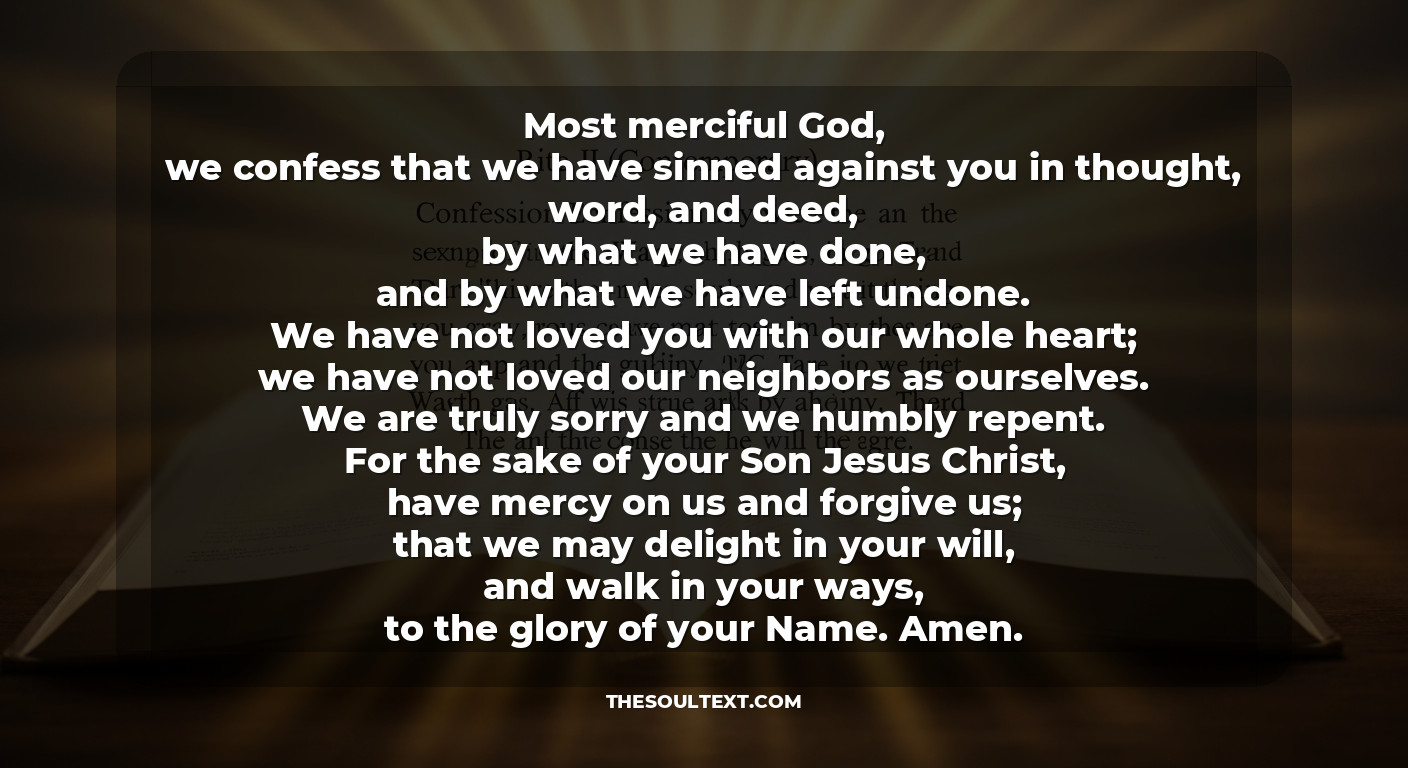
2. The General Confession (Rite II)
Most merciful God,
we confess that we have sinned against you in thought, word, and deed,
by what we have done,
and by what we have left undone.
We have not loved you with our whole heart;
we have not loved our neighbors as ourselves.
We are truly sorry and we humbly repent.
For the sake of your Son Jesus Christ,
have mercy on us and forgive us;
that we may delight in your will,
and walk in your ways,
to the glory of your Name. Amen.
This prayer is spoken by everyone together during most Sunday services in the Episcopal Church, usually before receiving Holy Communion. It’s our way of openly admitting our need for God’s forgiveness as a community.
“If we confess our sins, he is faithful and just to forgive us our sins and to cleanse us from all unrighteousness.” (1 John 1:9)
Episcopal Confession Prayer Traditional Text (Rite I)
When your spirit feels burdened by what you’ve done or left undone, finding true peace seems far away. The Episcopal Confession Prayer Traditional Text (Rite I) offers a timeless path to release, a way we’ve humbly brought our shortcomings before God for generations, seeking His restoring grace.
3. The General Confession (Rite I)
Almighty and most merciful Father; We have erred, and strayed from thy ways like lost sheep. We have followed too much the devices and desires of our own hearts. We have offended against thy holy laws. We have left undone those things which we ought to have done; And we have done those things which we ought not to have done; And there is no health in us. But thou, O Lord, have mercy upon us, miserable offenders. Spare thou those, O God, who confess their faults. Restore thou those who are penitent; According to thy promises declared unto mankind in Christ Jesus our Lord. And grant, O most merciful Father, for his sake; That we may hereafter live a godly, righteous, and sober life, To the glory of thy holy Name. Amen.
Do Episcopalians Pray the Rosary? (Anglican vs. Catholic)
The short answer is yes, many Episcopalians do pray the Rosary. Because the Episcopal Church considers itself the “Via Media” (the Middle Way) between Protestantism and Catholicism, personal devotions are highly flexible. While it is never a mandatory requirement, using beads for tactile, contemplative prayer is a deeply cherished practice for many members of the congregation.
However, when you see an Episcopalian praying with beads, they might be using one of two very different styles:
1. The Traditional Catholic (Dominican) Rosary
Many “High Church” or Anglo-Catholic Episcopalians use the exact same 59-bead rosary that Roman Catholics use. They meditate on the Joyful, Sorrowful, Glorious, and Luminous mysteries, and they pray the traditional Hail Mary. Because Episcopalians believe in the communion of saints, asking for the Blessed Virgin Mary’s intercession is a perfectly acceptable and historical Anglican practice.
2. The Anglican Rosary (Anglican Prayer Beads)
In the 1980s, an Episcopal priest named Rev. Lynn Bauman developed a distinctly Anglican set of prayer beads. This variation blends Protestant and Catholic traditions into a beautiful, customizable devotional tool. The Anglican Rosary is entirely different in structure and meaning:
- The Bead Count: Instead of 59 beads, the Anglican Rosary has exactly 33 beads, representing the 33 years of Jesus Christ’s earthly life.
- The Layout: It is divided into four groups of seven beads called “Weeks” (representing the 7 days of creation, the days of the week, and the seasons of the Church year). These are separated by four “Cruciform” beads, which form the shape of a cross.
- The Focus: While the Catholic Rosary is strictly Marian (focused on Mary), the Anglican Rosary is incredibly adaptable. Believers can choose their own prayers. Many use it to pray the Jesus Prayer (“Lord Jesus Christ, Son of God, have mercy on me”), the Trisagion, or specific verses from the Book of Common Prayer.
Ultimately, whether an Episcopalian chooses the Marian devotion of the Catholic Rosary or the Christ-centred flexibility of the Anglican Prayer Beads, the goal is the same: to slow down a busy mind, engage the physical body in worship, and create a quiet space to listen to the voice of God.
Episcopal Confession and Absolution (the Reconciliation of a Penitent)
You know, our journey of faith often leads us to seek deeper connection and healing. While we confess our sins together in public worship, the Episcopal Church also offers a particular, private opportunity for Confession and Absolution, formally known as the Reconciliation of a Penitent. It’s a sacred encounter for those who feel a pressing need for direct, personal assurance of God’s forgiveness.
This practice finds its roots firmly in Christ’s own commission to His apostles. As we read in John 20:23, after His resurrection, Jesus breathed on them and said, “Receive the Holy Spirit. If you forgive anyone’s sins, their sins are forgiven; if you do not forgive them, they are not forgiven.” This isn’t a grant of personal power to a priest, but an apostolic ministry to administer God’s grace to the Church.
It means the priest acts as an instrument, a minister of Christ’s reconciling love, offering the Church’s absolution and anointing. The priest stands not as judge but as a shepherd, helping you lay down your burdens directly before God, through the ministry of His Church. It’s a deep way to hear God’s mercy spoken aloud.
St. Paul speaks of this beautiful calling in 2 Corinthians 5:18-20, explaining that God “reconciled us to himself through Christ and gave us the ministry of reconciliation.” We, as Christ’s ambassadors, appeal to you on God’s behalf: be reconciled to God. This sacrament extends that ministry, creating a space for you to fully embrace that reconciliation.
This isn’t a new concept in God’s covenant with humanity. Even in the Old Testament, we see the importance of verbal confession. In Leviticus 5:5-6, for example, if someone sinned, they were to “confess the sin they have committed” before making an offering. This shows a long history of seeking restoration through a ritual act involving explicit acknowledgment.
The Episcopal Church understands this as an optional, yet deeply therapeutic and freeing, act of grace. When you bring your honest self, your struggles, and your sorrow for sin to this encounter, you’ll receive God’s mercy and a clear sense of spiritual renewal. It’s a chance to truly begin again, unburdened and at peace within the communion of saints.
Does the Episcopal Church Have Nuns and Monks?
“Does the Episcopal Church have nuns and monks?” This is a wonderful question often asked, and it’s a joy to affirm that yes, we absolutely do. Within the Anglican Communion, which includes the Episcopal Church, we cherish a rich tradition of Religious Orders for both men and women, living consecrated lives dedicated to God.
These brothers and sisters commit themselves to Christ through specific vows, commonly poverty, chastity, and obedience. Their lives are centered on deep prayer, worship, and active service, often lived within a supportive communal setting. This ancient way of life is a sincere expression of Christian discipleship, deeply embedded in our historical understanding of faith and spiritual practice.
You’ll find these orders serving God’s people in various capacities: running retreat centers, caring for the marginalized, offering spiritual guidance, engaging in teaching, or committing themselves to quiet, contemplative prayer for the world. Their intentional path helps them keep their focus purely on Christ and the work of His kingdom, unburdened by many worldly distractions.
Consider the early Christian community described in Acts 4:32-35. The scripture says, “Now the whole group of those who believed were of one heart and soul, and no one claimed private ownership of any possessions, but everything they owned was held in common.” This passage shows us a powerful vision of shared life and resources, a unity of spirit that clearly reflects the intentions behind many religious communities even today. It highlights a common pursuit of God’s will, moving beyond individual earthly concerns.
This radical form of discipleship is a specific calling for some, asking them to give their entire being over to following Jesus with a particular intensity. While not every Christian is called to this explicit path, these communities stand as strong, living witnesses to dedication and deep self-giving love within our church. They show us how a life given over completely to God can look, inspiring all of us.
Our Broad Church tradition truly celebrates this diversity in Christian living. We see these communities as vital parts of our spiritual family, bringing unique gifts of prayer, service, and witness to the entire body of Christ. They are living reminders that there are many authentic ways to answer God’s call to holiness and deep devotion in Christ, enriching our common worship and strengthening our connection to God and to one another.
Does the Episcopal Church Have Saints? (holy Women, Holy Men)
Does the Episcopal Church have saints? It’s a great question, and the answer is a resounding ‘Yes!’ In fact, you’re one of them. We believe that every baptised Christian is a saint – a holy person set apart by God for His purposes.
When Paul writes to the believers in Rome, he addresses them as ‘to all God’s beloved in Rome, who are called to be saints’ (Romans 1:7). This isn’t just a title for a select few; it’s our fundamental identity in Christ. We’re all called to live lives reflecting God’s holiness in the world, living out the baptismal covenant each day.
Beyond this universal calling, we also lovingly remember and honor particular holy women and holy men whose lives offered an extraordinary witness to God’s grace. These are the individuals we find celebrated in our liturgical calendar. They’re not worshipped, but rather held up as examples of deep faith and selfless service to Christ.
We commemorate these saints not because they stand between God and us, but because their stories provide inspiration and models of discipleship. They show us how deeply faith can be lived, and how varied God’s callings can be. Their journey helps us understand our own Christian walk better, letting us know we’re part of a vast family of faith stretching across time. We draw strength from their enduring witness to God’s love and justice in the world.
These holy ones point us directly to Christ, who is the source of all holiness. Their lives testify to the power of God working through ordinary people to do extraordinary things. They remind us that even in our own time, faithfulness, courage, and love can make a real difference, encouraging us in our own journey of faith and service and prompting us to embody Christ’s love for all.
Does the Episcopal Church Have Communion? (the Eucharist)
When you ask if the Episcopal Church has Communion, we can definitively say, yes, we do. The Holy Eucharist, often called the Mass or Holy Communion, stands at the very heart of our common life and worship. It’s not just a symbolic meal; it’s the very source and summit of our spiritual journey, deeply rooted in the ancient Catholic tradition we uphold.
Our understanding springs directly from Christ’s own words at the Last Supper. As St. Paul recounts in 1 Corinthians 11:23-26, Jesus took the bread, broke it, and said, “This is my body, which is for you. Do this in remembrance of me.” He did the same with the cup, saying, “This cup is the new covenant in my blood. Do this, as often as you drink it, in remembrance of me.” This isn’t a mere memorial; it’s a deep action of presence.
We truly believe in the Real Presence of Christ in the consecrated bread and wine. When the priest prays the words of institution over the elements, the Holy Spirit comes, making Christ truly present for us to receive Him. It’s a mystery, certainly, but one we receive with faith, trusting in His promise.
Think of Christ’s words in John 6:53-56: “Unless you eat the flesh of the Son of Man and drink his blood, you have no life in you. Those who eat my flesh and drink my blood have eternal life, and I will raise them up on the last day.” Our Lord spoke plainly about this sacred food and drink. It’s spiritual sustenance essential for our salvation and growth in grace, making us one with Him and with each other.
The Eucharist is our participation in the one, perfect sacrifice of Christ on the cross, made present to us in the here and now. We don’t re-sacrifice Him, but we’re brought into the saving power of His Passion and Resurrection. In every Mass, you’re meeting Christ Himself, receiving His grace, His forgiveness, and His divine life within you. This is how we’re nourished and built up as the Body of Christ in the world.
How to Do Confession in the Episcopal Church (step-by-step)
When you’re considering confession in the Episcopal Church, it’s important to remember it’s a way to find grace and reconciliation, not judgment. We believe in God’s unending love and willingness to forgive, always. Private confession, also called the Reconciliation of a Penitent, is a powerful, optional rite for when you need a more direct and personal experience of forgiveness.
It’s a chance to unburden your heart and receive God’s mercy through the ministry of a priest. As Proverbs 28:13 reminds us, ‘Whoever conceals their sins does not prosper, but anyone who confesses and renounces them finds mercy.’ This is about finding freedom and renewal in Christ.
- Prepare Your Heart. Before you meet with a priest, take some time for honest self-examination. Reflect on your life, praying to the Holy Spirit to show you where you’ve fallen short in thought, word, deed, or omission. You might use a guide like the Ten Commandments or the Baptismal Covenant to help you think through your actions. This isn’t about shame; it’s about clear-eyed honesty with God.
- Arrange Your Confession. You’ll usually contact your parish priest to schedule a time for confession. It often takes place in a quiet, private space, like the priest’s office or a chapel, not typically a confessional booth as in some other traditions. You can choose to kneel or sit; the emphasis is on comfort and direct conversation.
- Begin the Rite. The priest will start with a prayer, and you’ll then confess your sins openly and honestly. Speak freely about what troubles you, knowing that the priest is there as a witness to your repentance and a channel of God’s grace. We aren’t here to judge; we’re here to offer compassion and guidance.
- Receive Counsel and Absolution. After you’ve shared your confession, the priest might offer a brief word of counsel, encouragement, or an appropriate spiritual discipline (often called penance), which isn’t a punishment but a way to strengthen your resolve or make amends. Then, the priest will pronounce absolution, declaring God’s forgiveness and setting you free from the burden of your sins. This is the heart of the rite – God’s grace pouring over you.
- Move Forward in Peace. Once you’ve received absolution, the rite concludes with a prayer and a dismissal. You can leave knowing you’re reconciled with God and the Church, with a renewed spirit. You’ll feel a tangible sense of peace and a fresh start, ready to walk more closely with Christ in your daily life.
The Prayer of Humble Access Traditional Text (communion Preparation)
Feeling unworthy as you approach the Lord’s Table is a very real human struggle. It’s in those quiet moments, when we crave a deeper connection, that ‘The Prayer of Humble Access Traditional Text (communion Preparation)’ has served for centuries. It helps prepare our hearts, making us ready to receive Christ.
14. Preparing Our Hearts for Holy Communion
We do not presume to come to this thy Table, O merciful Lord, trusting in our own righteousness, but in thy manifold and great mercies. We are not worthy so much as to gather up the crumbs under thy Table. But thou art the same Lord, whose property is always to have mercy: Grant us therefore, gracious Lord, so to eat the flesh of thy dear Son Jesus Christ, and to drink his blood, that our sinful bodies may be made clean by his most precious Body, and our souls washed through his most precious Blood, and that we may evermore dwell in him, and he in us. Amen.
Short Daily Confession of Sins (compline)
When the day closes, a craving stirs within us to set things right before rest. Here, the blessed practice of a Short Daily Confession of Sins (compline) offers a truly gentle rhythm.
It’s a moment in the Episcopal tradition, preparing your soul for the peace only God can provide.
15. The Evening’s Embrace
Before you lay down to sleep, don’t carry yesterday’s missteps into the quiet night. Offer your heart in a short daily confession; God’s loving grace will meet you, making you ready for true rest.
16. A Gentle Accounting
Take a moment at day’s end to look back, not to judge harshly, but to see where love wasn’t fully shown. A quiet admission brings clarity, helping you grow closer to God’s likeness.
17. Sleep’s True Gift
You won’t find deep rest carrying the weight of unconfessed faults. Through a brief compline confession, give them over; God provides the peace that truly calms your spirit for the night.
18. Trust in Mercy
Don’t ever doubt the vastness of God’s mercy. Even the smallest daily confession opens you to an ocean of forgiveness. You’re always held in God’s unending love, no matter your human failing.
19. Release Your Load
Let go of what weighs you down at day’s end. A simple confession isn’t about shame; it’s about handing your burdens to Christ, who’s ready to lift them, so you don’t carry them alone.
20. Each Day’s New Dawn
A short evening confession washes clean the slate of your day. It means you can greet the new morning not with regret, but with a spirit renewed and ready for fresh beginnings.
21. The Humble Heart
It takes real humility to name our missteps, even small ones. This daily act isn’t weakness; it’s a strength that opens your heart wider to God’s grace and makes you truly teachable.
22. Closer to God
When you quietly confess your sins, you’re not distancing yourself from God; you’re actually drawing nearer. It’s an honest conversation that deepens your bond with divine, forgiving love.
23. Ready for Tomorrow
Preparing for tomorrow starts with making peace today. A sincere evening confession helps you clear your mind and spirit, making you present and open to God’s will in the coming day.
24. In Sacred Silence
In the quiet of compline, allow space for reflection. Your short daily confession of sins isn’t just words; it’s a silent turning of your whole being toward God’s light, found in honest quiet.
How to Do an Examination of Conscience (episcopal Style)
Undertaking an examination of conscience is a vital spiritual discipline within the Episcopal tradition. It’s not about self-flagellation, but a loving invitation to honest self-reflection, allowing us to grow closer to God. This prayerful process helps you recognize where your will aligns with God’s and where it’s strayed.
It’s an act of deep introspection, guided by the Holy Spirit. We seek to understand our motivations, actions, and even our omissions, holding them up to the light of Christ’s perfect love. This practice prepares your heart for repentance and a renewed commitment to Christ-like living.
- Begin with Invocation. Start by quieting your spirit and asking for God’s grace. You’ll want to invite the Holy Spirit to guide your thoughts, just as we hear in John 14:26, where the Advocate promises to teach us everything. This isn’t a solitary journey; it’s one walked with divine assistance.
- Reflect on God’s Law and Your Life. Consider the Two Great Commandments: to love God with all your being and your neighbor as yourself, as Jesus teaches in Mark 12:30-31. Think about how well you’ve embodied these loves in your daily interactions, your work, and your relationships. You can also use the Beatitudes or the Ten Commandments as guides.
- Examine Specific Areas of Failure. With the Holy Spirit’s help, identify specific instances where you’ve fallen short. This means looking at your thoughts, words, deeds, and even what you’ve failed to do. As Psalm 139:23-24 suggests, ask God to search your heart and reveal any ‘offensive way’ in you. This helps you name your sins honestly before God.
- Cultivate Contrition and Sorrow. Allow yourself to feel true sorrow for your sins, not just regret for consequences. This is a humble, brokenheartedness that God doesn’t despise, as Psalm 51:17 beautifully expresses. It’s a genuine desire to turn away from sin and toward God.
- Form a Firm Purpose of Amendment. After recognizing your failings, commit to making amends and changing your ways. This isn’t just wishing things were different; it’s a resolve to actively strive for holiness. You’re not dwelling on the past but pressing forward, as Paul encourages in Philippians 3:13-14, towards God’s calling.
- Conclude with a prayer for Absolution. Close your examination with a prayer asking for God’s forgiveness and strength to live more faithfully. You can also seek sacramental confession with a priest, knowing that the Church offers the ministry of reconciliation, as seen in 2 Corinthians 5:18-20. This allows for an external declaration of God’s pardon.
This regular spiritual practice strengthens your relationship with Christ, drawing you deeper into His mercy and grace. It’s a pathway to spiritual growth and renewed purpose.
Prayers for Anglican Prayer Beads (Sample Formats)
Unlike the traditional Dominican Rosary, the 33-bead Anglican Prayer Bead chaplet does not have one strict set of required prayers. Instead, it is a flexible, contemplative tool.
The 33 beads represent the years of Christ’s earthly life, divided into the Cross, the Invitatory bead, four Cruciform beads, and four “Weeks” (sets of 7 beads). Below are the most beloved, historically rich sample formats you can use to guide your meditation.
1. Sample 1: The Trisagion and Jesus Prayer
The Cross: In the Name of God, Father, Son, and Holy Spirit. Amen.
The Invitatory: O God make speed to save us. O Lord make haste to help us. Glory to the Father, and to the Son, and to the Holy Spirit: As it was in the beginning, is now, and will be forever. Amen.
The Cruciforms: Holy God, Holy and Mighty, Holy Immortal One, have mercy upon us.
The Weeks (7 beads): Lord Jesus Christ, Son of God, have mercy on me, a sinner.
2. Sample 2: The Julian of Norwich Prayer
The Cross: In the Name of God, Father, Son, and Holy Spirit. Amen.
The Invitatory: O God make speed to save us. O Lord make haste to help us.
The Cruciforms: God of your goodness, give me yourself, for you are enough to me. And I can ask for nothing less that is to your glory. And if I ask for anything less, I shall still be in want, for only in you have I all.
The Weeks (7 beads): All shall be well, and all shall be well, and all manner of things shall be well.
3. Sample 3: An Evening Compline Rest
The Cross: Glory to the Father, and to the Son, and to the Holy Spirit. Amen.
The Invitatory: Open my lips, O Lord, and my mouth shall proclaim your praise.
The Cruciforms: Guide us waking, O Lord, and guard us sleeping; that awake we may watch with Christ, and asleep we may rest in peace.
The Weeks (7 beads): Jesus, lamb of God, have mercy on us. Jesus, bearer of our sins, have mercy on us. Jesus, redeemer of the world, give us your peace.
4. Sample 4: A Celtic Invocation
The Cross: In the Name of God, Father, Son, and Holy Spirit. Amen.
The Invitatory: O God make speed to save us. O Lord make haste to help us.
The Cruciforms: Be the eye of God dwelling with me, the foot of Christ in guidance with me, the shower of the Spirit pouring on me, richly and generously.
The Weeks (7 beads): I bow before the Father who made me, I bow before the Son who saved me, I bow before the Spirit who guides me, in love and adoration.
5. Sample 5: The St. Francis Peace Prayer
The Cross: Blessed be the one, holy, and living God. Glory to God forever and ever. Amen.
The Invitatory: Create in me a clean heart, O God, and renew a right spirit within me.
The Cruciforms: Lord, make me an instrument of your peace. Where there is hatred, let me sow love; where there is injury, pardon; where there is doubt, faith; where there is despair, hope; where there is darkness, light; where there is sadness, joy.
The Weeks (7 beads): O Lord, make me a channel of your peace.
“The Comfortable Words” Traditional Text (assurance of Forgiveness)
When your spirit feels heavy, craving rest, you need God’s loving promise. The timeless ‘the Comfortable Words’ Traditional Text (assurance of Forgiveness) has long settled anxious hearts. As a Liturgical Scholar, I see their enduring power in our worship, truly bringing comfort.
6. Words of Divine Comfort
Hear what comfortable words our Saviour Christ saith unto all who truly turn to him.
COME unto me, all ye that travail and are heavy laden, and I will refresh you. St. Matthew xi. 28.
Hear also what Saint John saith.
SO God loved the world, that he gave his only-begotten Son, to the end that all that believe in him should not perish, but have everlasting life. St. John iii. 16.
Hear also what Saint Paul saith.
THIS is a true saying, and worthy of all men to be received, that Christ Jesus came into the world to save sinners. 1 Tim. i. 15.
Hear also what Saint John saith.
IF any man sin, we have an Advocate with the Father, Jesus Christ the righteous; and he is the propitiation for our sins. 1 St. John ii. 1, 2.
The Prayer for Spiritual Communion Traditional Text
When physical presence at the altar isn’t possible, our hearts still crave the Lord. The Prayer for Spiritual Communion Traditional Text offers a way to truly connect with God’s grace, echoing a long history in the Church. It’s for those times you really want to receive Jesus, even when circumstances keep you apart.
7. The Prayer for Spiritual Communion
My Jesus, I believe that you are truly present in the Most Holy Sacrament. I love you above all things, and I really want to receive you into my soul. Since I can’t receive you sacramentally right now, come spiritually into my heart. I embrace you as if you were already there and unite myself wholly to you. Never let me be separated from you. Amen.
Episcopal Prayer for Guidance and Cleansing
When your path feels foggy, or the weight of past mistakes tries to hold you down, it’s easy to feel lost or unworthy. But your spirit craves clarity and freedom.
An Episcopal Prayer for Guidance and Cleansing isn’t just words; it’s a heartfelt opening, letting God’s grace wash over you, showing you the way forward with a pure heart.
8. Wisdom’s Clear Light
Heavenly Father, I stand before You needing wisdom, a real sense of where to go next. When I don’t know what to do, please show me. I trust You won’t hold back, giving generously when I ask, just as James 1:5 promises. Clear my mind and help me see Your path, so I can walk with sure steps, not stumbling in my own thoughts.
9. Spirit’s Fresh Start
God of all mercy, my spirit feels cluttered, and I know I carry things that aren’t from You. I ask You now, as You promised in Ezekiel 36:25, to sprinkle clean water over me. Make me new. Take away this heart of stone and give me a heart that beats for You alone. I want to feel Your presence, fresh and pure, guiding my every action.
10. Paths Made Plain
Lord, You are my shepherd, and I really want to follow where You lead. Show me Your ways, God, and teach me Your paths, just like Psalm 25:4-5 asks. Don’t let me wander off course with my own limited understanding. Direct my steps today and every day, making Your intentions for me clear and easy to follow. I’m ready to learn from You.
11. Conscience Purified
Jesus, Your blood poured out for me is powerful beyond measure. I bring my conscience before You, asking for it to be purified from all dead works and guilt, just as Hebrews 9:14 declares. Let Your sacrifice clean every stain and thought that keeps me from serving You fully. I want a conscience clear and free, ready to live for Your purpose.
12. Hearing Your Voice
Father, sometimes the world’s noise drowns out Your soft whisper. Today, I open my ears to hear Your word behind me, saying, “This is the way; walk in it,” as promised in Isaiah 30:21. Cut through the confusion and distractions. Make Your instruction clear and unmistakable, so I can step confidently into the direction You have for me, without doubt or hesitation.
13. Body and Spirit Made Clean
God, I want to honor You with my whole being. I come before You now to purify myself from everything that contaminates my body and spirit, as 2 Corinthians 7:1 commands. Show me any hidden areas where I’m holding onto things that aren’t of You. Wash them away completely, so I can be truly consecrated and devoted to Your will, inside and out.
14. Trusting Your Lead
Lord, it’s hard to always know the best way. I choose to trust in You with all my heart and not lean on my own ideas, just as Proverbs 3:5-6 guides me. Please make my paths straight. Wherever I go, help me see Your hand, knowing You’re directing me, even when I don’t fully understand. I put my full faith in Your leading.
15. Redeemed and Pure
Jesus, thank You for giving Yourself for me, to redeem me from all wickedness and purify me for Your own possession, just as Titus 2:14 states. I claim that redemption now. Wash away every trace of past wrongs and present temptations. Make me truly Your own, a clean vessel ready to reflect Your goodness and serve Your purposes in this world.
16. Spirit’s True Direction
Holy Spirit, You are the Spirit of Truth, and Jesus promised You’d guide me into all truth, as John 16:13 assures me. I welcome Your guidance now. Lead me, not just with ideas, but with a deep, knowing peace. Show me the next step, the right words to say, and the people I’m meant to connect with. Let Your truth be my only compass.
17. Hidden Faults Exposed
God, You see everything, even what I miss in myself. I ask You to declare me innocent from hidden faults, as David pleaded in Psalm 19:12. Shine Your light into the corners of my heart I haven’t examined. Forgive what I’ve unknowingly done wrong. Cleanse me of any secret sin, so I can walk openly and honestly before You, without anything hidden.
Closing Thought: the Peace of the Lord
When we offer one another “The Peace of the Lord” in our worship, it’s far more than a simple greeting. It’s an ancient, living prayer, a deep exchange rooted in Christ’s own words and presence among us. This isn’t just about feeling calm or the absence of outward conflict, though those are good things. It’s about a spiritual wholeness, a deep assurance that only God can give.
This peace is a gift, not something we earn or manufacture on our own. Think about what Jesus told his disciples, especially as he prepared them for his departure: “Peace I leave with you; my peace I give to you. Not as the world gives do I give to you. Let not your hearts be troubled, neither let them be afraid.” (John 14:27). He makes it clear that his peace is different; it’s got a lasting quality, a strength that worldly conditions can’t shake.
In our worship, when we turn to a neighbor and share this peace, we’re not just being friendly. You’re actively participating in Christ’s gift, passing on that very assurance to one another. You’re acknowledging the divine peace within them and inviting it to strengthen you too. It’s a sign of reconciliation, a reminder that we’re all part of one body, breaking down the small walls we might build between us.
This peace helps you carry forward the grace you’ve received in confession and communion. You don’t have to face the world’s worries alone; you carry this divine calm with you. It helps you remember that even in challenging times, God’s steadfast love is present, offering rest for your soul. We’re called to be people who carry this peace into every corner of our lives, to be instruments of God’s reconciling love in a world that craves it so much.
So, as you hear or say those words, know that you’re not just ending a service or a prayer. You’re being sent out, commissioned with a divine gift. It’s a peace that holds you, guides you, and calls you to share its quiet power with everyone you meet. It’s a reminder that Christ is always with us, just as he promised, bringing his own unique peace.
A Closing Benediction
Merciful God, we bring before you the earnest thoughts and spoken words regarding confession within the Episcopal Church.
You see the heart’s questions about ‘Is Confession Required in the Episcopal Church? (the Rule)’, and you hear the quiet pleas found in both the ‘Episcopal Confession Prayer Traditional Text (rite II Contemporary)’ and the revered ‘Episcopal Confession Prayer Traditional Text (rite I)’. We ask that you answer these petitions, guiding each soul as it seeks your grace.
Please know, you’re not speaking into a space. God truly hears your every cry, whether it’s a shouted prayer or a silent lament. He’s always near, listening intently to your honest words, the ones you share in your quiet moments of reflection.
You don’t need to doubt that your voice reaches Him. He knows what you carry; He’s here for you, always ready to extend His peace.
May God’s peace come over you now, settling your spirit and strengthening your heart. May you feel His presence guiding your way, bringing clarity and calm to your journey. You are seen, you are heard, and you are loved beyond measure.
May you find great peace in considering the Episcopal Church Confession: Prayers, Rosary & Do They Have Nuns?

Alex Foxy is a dedicated researcher and writer with over 8 years of experience exploring the intersection of Biblical theology, prophetic dream interpretation, and relational wellness. He specializes in breaking down complex spiritual themes into practical, life-changing insights that help people navigate their darkest seasons with clarity and hope. Outside of his deep dives into scriptural jurisprudence and spiritual warfare, Alex is a fan of early morning hikes, exploring rare bookstores, and mentoring young leaders. He believes that every dream has a meaning and every relationship has a divine purpose.